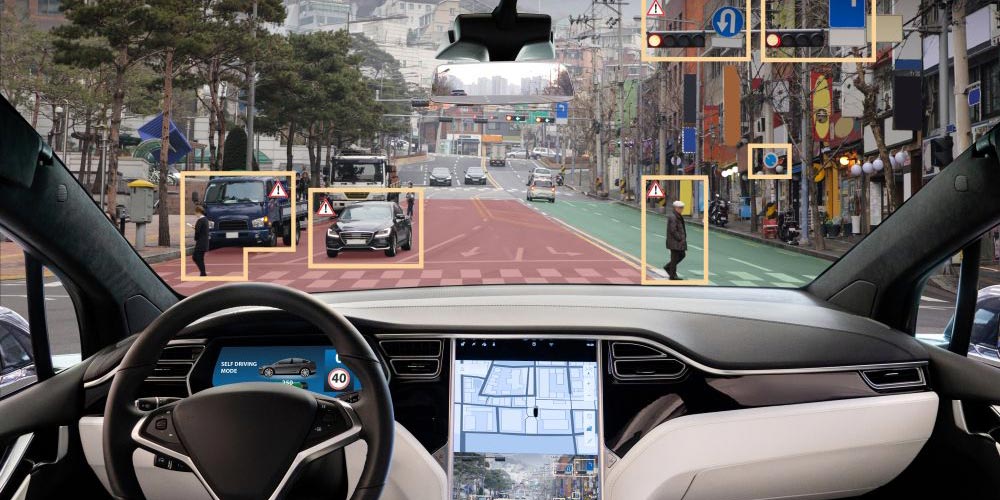
In October 2005, two major automakers revealed distinct courses in autonomous driving technology. General Motors said it will outfit the 2028 Cadillac Escalade IQ with a Level 3 autonomous driving system, which comprises multiple sensors, including LiDAR, cameras, and radar.
Competing Technologies Vie for Self-Driving Dominance
Meanwhile, Tesla doubled down on its commitment to a camera-only neural network architecture with the release of Full Self-Driving (FSD) v14, the company's first major software update in a year. The system continues to analyze data from embedded AI-powered vision cameras to detect objects and plan routes.
Many autonomous cars on the market have adopted a multisensor approach similar to GM's. Robotaxis from Waymo, which operate in nine U.S. cities as of May 2026, are equipped with LiDAR, cameras with 360-degree vision, radar, ultrasonic sensors, and audio receivers. The vehicles rely on semiconductors featuring ultra-high-bandwidth memory to process sensor data and update 3D maps in real time.
A critical technology in autonomous driving is LiDAR, which has transitioned from mechanical scanning units to much cheaper solid-state sensors. These eliminate moving parts and improve reliability. Frequency-modulated continuous wave LiDAR integrates velocity detection with traditional 3D spatial mapping. FMCW systems, which are starting to use silicon photonics to develop compact sensors for automotive applications, also perform better in bad weather compared to traditional LiDAR.
But are cameras alone up for the job of autonomous driving? Embedded cameras generate approximately 1 GB of data per second. Data loads can impose 150–200 ms of latency, which makes the car rather than the distant cloud ideal for data processing. Edge AI processors now offer the computational power to run advanced neural networks locally.
So, is one technology better than the other to drive us safely, quickly, and accurately from point A to point B? It's too soon to tell, but both multisensor redundancies and vision-only systems will require breakthroughs in component technologies, including high-resolution imaging and edge computing.
Learn more about the competing approaches to autonomous driving and the technologies advancing both multisensor and vision-only systems in this A3 blog post.
Contact Us Today
Need help marketing your machine vision, sensing, and automation technologies? Contact us today.
“The future of autonomous driving may depend less on which sensors win than on how quickly vehicles can process what those sensors see.”