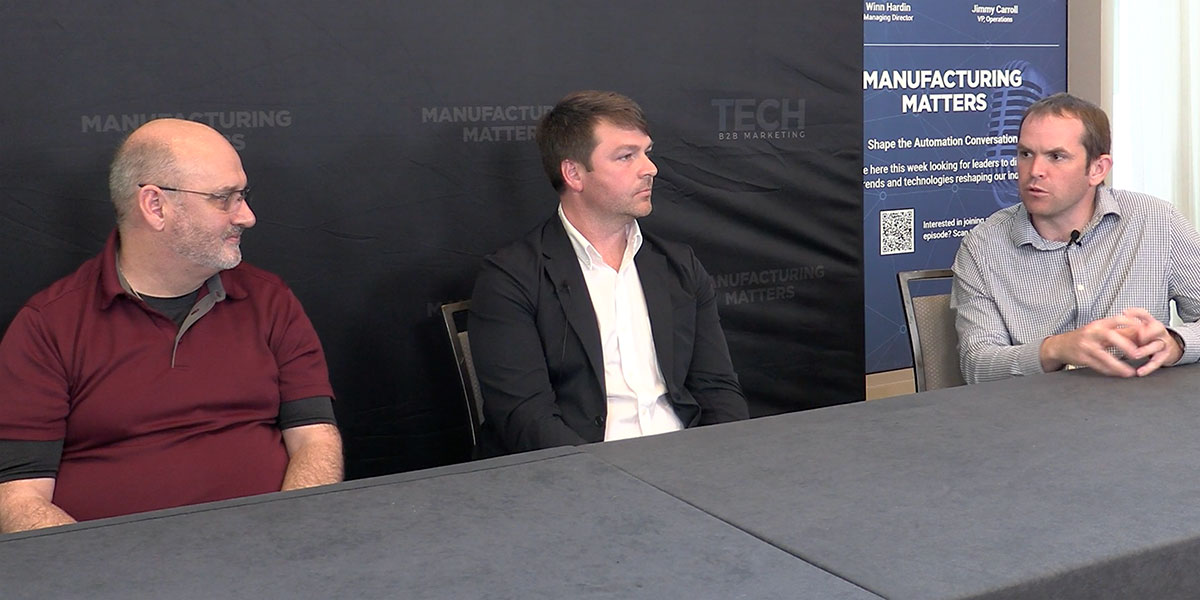
Almost every guest on the Manufacturing Matters podcast gets around to the same worry sooner or later. Robots and industrial automation technologies keep getting better. Someone still must program, operate, maintain, and troubleshoot these systems, and there aren't enough of those people. We've heard that from education program leaders and from a recruiter who spends her days on the phone with plant managers, and a trade association CEO gave us the same answer. They agree the problem is real and mostly agree on what helps. Where they split is what AI does to the jobs that remain.
Automation Needs People: Closing the Skills Gap
Toward 2 million open manufacturing jobs
Suzy Teele, chief strategy officer at the ARM Institute, told us last year that "there's about 800,000 that are open right now in manufacturing." Jay Timmons, president and CEO of the National Association of Manufacturers, put it at "400,000 open jobs in the sector today. That grows to 2 million by the year 2033." On our AI panel at the 2026 A3 Business Forum, Melonee Wise of KUKA cited "1.1 million open jobs" across manufacturing and logistics.
Those figures come from different months and different definitions, but the point is clear, which is that the number of open jobs in manufacturing and industrial settings is a concern. Teele's version of the stakes is the blunt one: "we can't grow manufacturing if we can't find people to work in it." Timmons added a wrinkle we hadn't considered. Immigration enforcement is opening vacancies in other parts of the economy, and "we're competing for that same labor."
Start them young
Teele's view is that the pipeline has a perception problem. "There's a perception that a trade career path is not as valuable as going to a four-year or plus educational program," she said, adding that it is slowly changing. Her fix is to "start to introduce the concept of a manufacturing career to somebody a lot younger in their life," meaning 7 or 8 years old, when kids are still saying they want to be a firefighter or a doctor.
Christelle Keefer, now director of training and certification at A3, agrees and gets specific about how. When we spoke she was running education outreach at ABB Robotics. She wants robotics classes "directly in the curriculum, not just in after-school programs," because students without a ride home can't stay late. And she is wary of one-day events: "The key is making the program systematic, not just a one-off event."
Teele's organization built one resource aimed at this, RoboticsCareer.org, which catalogs "over 17,000 training programs" and averages "2,000 jobs every day" for people to browse.
Showing up beats spending
A particularly insightful part of the Keefer conversation was the question of what a small integrator or distributor with no education department should do. Her answer was "Start local. Partner with a school, sponsor a robotics team, offer tours of your facility, or, you know, you could host a career day." She was firm that money isn't the constraint: "You really don't need a big budget to make an impact, but consistency in showing up and investing time matters."
Plenty of engineers worry they need a polished presentation, but Keefer doesn’t think they do. "The kids don't want a PowerPoint presentation," she said. If a student asks something you can't answer, "you're both learning."
Don’t lose your tribal knowledge
Not every worker you need is going to be young. Keefer described adults who changed careers by taking a robot safety course, then moving on to programming, "and then eventually becoming a robot integrator." Community colleges and workforce development centers all came up, along with training from A3 and Tooling U-SME.
Teele named the small-manufacturer problem directly: they "can't afford to take a piece of equipment off-line in order to teach somebody how to use it." Her answer is simulation and VR, though she's honest that "almost every environment is custom," so the return on a custom VR build only works for some companies.
She also raised a risk that gets too little attention. "The average age of an employee in manufacturing is around 55 years old," she said, and the people who know how the equipment really behaves are leaving. AI can help capture that knowledge, but smaller shops often have no data to start from. "They've got Bob in the corner. And you know it's all in his brain, right?"
Candidates hold the cards
Denise Chludzinski, vice president of business development at Miller Resource Group, talked with us about what she sees on the recruiting side. On the plant floor, "that labor pool is just not there. And so what happens? You have to automate." Meanwhile, her technical candidates are in demand. "My control engineers, my PLC programmers, that continues to be a huge market," she said. For candidates willing to relocate, "they're going to have a lot of choices."
Her advice for employers is plain. Candidates are in the stronger position ("It's a tight labor market and I don't see that going away"), counteroffers are "very, very strong," and the companies winning are the fast and transparent ones. She also pushed back on the idea that it all comes down to pay: "It's salary, salary, salary. I have had people decline." What they want to know is that "their voice is heard." The first day matters more than most employers think. "We do all this work trying to recruit you into our company. And then the moment you're supposed to start, it's almost like you're forgotten."
Fewer junior jobs, or just different ones?
Here the guests really split. On the AI panel, Wise worried about the next rung of the ladder. Senior people are getting "large multipliers on their productivity, which right now is leading to less hiring of junior talent," and she wondered "how do we train junior talent to become senior talent." Her view is that retraining is a policy question: "That's not something that we as technologists are going to solve."
U.S. Rep. Jennifer McClellan, who is behind a bipartisan bill to create a national robotics commission, would put workforce first in that policy conversation. Her reasoning: "one of the downsides to how fast technology changes is your workforce is not prepared."
Juan Aparicio, founder and CEO of Reshape, has a rosier read from selling automation to factories. "I haven't seen any case where there were really layoffs because the robot started," he said, and he believes "more robots means more work." Adi Dalvi, vice president of sales at OSARO, summed up the panel's take in two words: "It's reallocation." Teele went further back in history. "There's never been a mass layoff in the history of the world as a result of advanced technologies," she said.
Both camps could be right. The jobs may move faster than the people who need them.
A starter list for this quarter
- Pick one local school and show up repeatedly. A facility tour or a judge's seat at a robotics competition counts.
- Look at your own people first. Who could move from operating to programming with the right course?
- Write down what your veteran employees know before they retire.
- Hire for what's missing. Chludzinski's rule is that you shouldn't "find a match to your culture. You want to find a complement to your culture."
- Plan a real first day for new hires, and ask people what keeps them, because it often isn't the pay.
- If you're curious what automation can do for your own staffing, talk to a robotics and automation specialist before the next hire, not after.
Go to the source
Episode 120 (Jay Timmons, NAM), Episode 127 (AI panel), Episode 141 (Rep. Jennifer McClellan), and Episode 145 (Denise Chludzinski, Miller Resource Group). They're all at manufacturing-matters.com and on YouTube.
Have questions about AI and deep learning in your industry, the podcast, or how TECH B2B Marketing helps automation companies tell their stories? Contact us today. We'd be happy to talk.