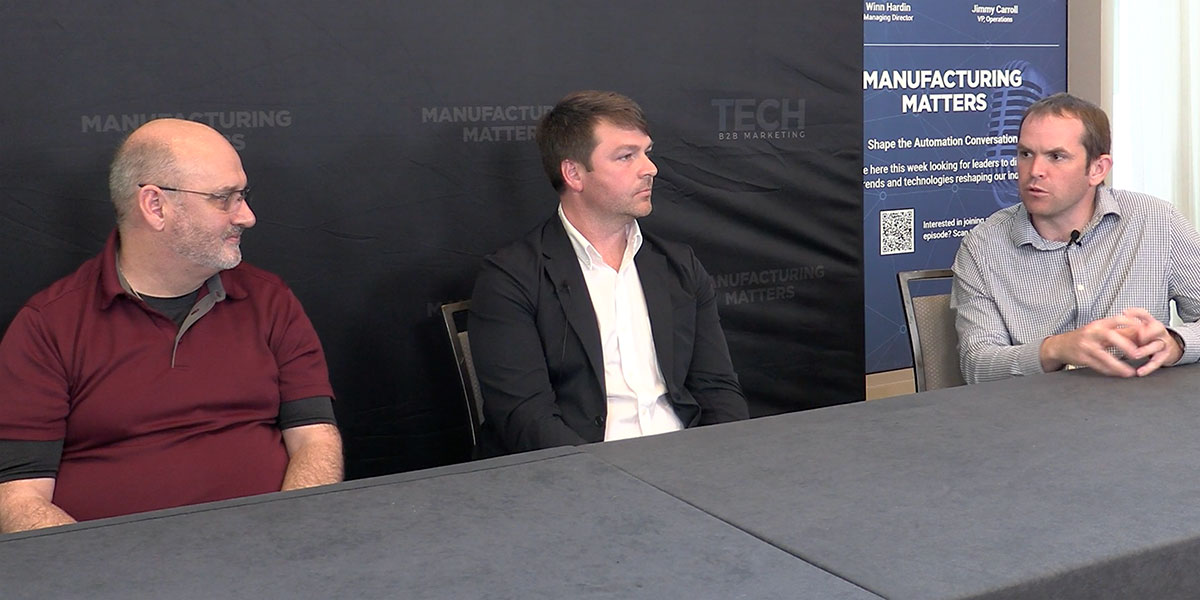
When we recorded our 100th episode of Manufacturing Matters in April 2025, tariff rules were changing by the week. We put four automation leaders on a panel about tariffs and supply chains to sort through it. Seven months later we heard from the head of a major manufacturing trade group and from a supply chain executive running a reshoring program. They don't agree on everything and the same complaint runs through all of it, though: companies are ready to invest in making things here, and they can't plan around costs that keep moving.
When $100 Million of Equipment Costs $140 Million
The great pause
Jay Timmons, president and CEO of the National Association of Manufacturers, described the mood as optimism with nowhere to go. "I'm seeing right now what I would call the great pause. Lots of capital sitting on the sidelines, just waiting to be invested." He gave us a real example. A small manufacturer wants to put $100 million into new equipment so her plant can be more efficient. He said that "with tariff policy, that same equipment would cost $140 million." She told him she didn't have the capital to cover the difference.
The NAM has a proposal for cases like this. Its Manufacturing Investment Accelerator Program would give manufacturers a speed pass to import critical inputs duty-free. Timmons made the case with one number: "you can only produce about 84% of the critical inputs necessary to build a new manufacturing operation." The rest has to come from abroad. As of our conversation it was still a proposal, and his summary of the real problem was blunt: "the biggest thing that the manufacturers need is certainty on anything."
The panel had flagged the same stall months earlier. Stu Shepherd, that year's recipient of the Engelberger Robotics Award for Leadership, expected "a lot of indecision and a lot of confusion," and noted that "most integrators can't afford to buy stock and anticipate demand." Gerd Walter of Creative Automation pointed out the mismatch in timelines. Some automotive programs run five to 10 years. "And you've got a president that's going to be in there with his policies for four years."
Reshoring pulls in two directions
Walter expected reshoring to split. Work already in the pipeline and critical to a company will come home. Other work won't, especially in labor-intensive automotive supply, where "they're looking even farther south than Mexico. They're looking to Nicaragua, Honduras, Colombia." Shepherd agreed that a lot of the earlier reshoring never reached the United States: "You go to Mexico, there's new plants everywhere you turn down there." He also warned that "made here" is slippery. He had just bought a vehicle. "Final assembly in the United States, but it's only 41% US content." He said a real move home can take "three to five years before you see the impact."
Jeff Stello, chairman of the board at Metaphase Technologies, thinks tariffs get too much credit. "Tariffs are only one aspect of what was starting to get people talking about onshoring," he said, pointing to tax incentives and the push to bring capital back to the US. Walter's guess was that the work coming home would be "the higher value or core competency arenas." Jason Covar, general manager for North America at The Imaging Source, added the part that gets skipped in a lot of reshoring talk: if a plant used to export, bringing it back for a domestic market only "looks a lot different" on the return calculation.
Walter also raised a wrinkle. With big tariffs on China, he said, "China can't sell to the US. They're just going to flood the rest of the world even cheaper." Some of his European suppliers, he told us, were already scared.
One company's numbers
Agustin Lopez Diaz was Schneider Electric's North American supply chain officer when we spoke, and he has since moved to Stanley Black & Decker as its chief global supply chain officer. At Schneider Electric he ran the supply chain for the whole region, and he was direct about the strategy: "U.S. for U.S." The numbers he gave us: "We were 60% coming out. Now 90% of our production is in the region, for the region." He also said Schneider's US factories "are really as competitive as pretty much anywhere else, from a cost perspective," though he credited the company's own automation and controls for part of that.
The program behind the resilience goal is called Power of Two. Schneider looked at every product down to the component level and set up double production for the critical ones, so that about 96% of its production now has a second site somewhere in the US or overseas. Diaz didn't pretend the goals fit together neatly. He said "we want to be resilient, flexible, and competitive. And all of those are almost against each other by nature." Schneider's answer is data: an analytical model that weighs "tariffs, localization, cost equation, lead times," built on visibility into every component and supplier.
When our own Winn Hardin noted that reshoring and redundancy together aren't easy to achieve, Diaz agreed: "Easier said than done." His advice for smaller companies was to "take a leap of faith and start getting data, start working on analytics and connected devices," though he admitted it's "a big investment."
Boring protection that works
Not every defense needs a visibility platform. Walter's company started "adding terms to cover tariffs a while back in our quotes," and had already added protective language for supply disruptions during the pandemic. His advice was plain: "Talk to your lawyers and see what language you've got in your quotes and in your terms."
Stello's company made a different bet. Metaphase "made a commitment to our customers in October not to raise prices in 2025," and planned to keep it as long as it could find alternate sources. Materials run "maybe 25% of the overall cost of our manufacturing," which gives the company some room. Smaller companies feel other things too. Stello said parts held up in customs hurt a small business's forecasting because "every day of production matters." And Walter's mood after years of one disruption after another was easy to share: "I think a lot of us are getting tired of crawling out of one thing after another."
Retrofit first, rebuild later
Shepherd also saw an opening in the mess: "every market disruption is a chance to adopt or adapt your strategies and methods of getting things done." When new equipment costs more and takes longer to arrive, the panel expected buyers to look again at what they already own. Shepherd said he was already seeing companies "looking at optimizing their current in-house equipment to try to squeeze more overall operating efficiency out of the current equipment," because new equipment carries a much higher "lead time and cost and duty impact." He also pointed to a market for used machinery: the lead time on surplus equipment "would be nearly zero other than deinstall and reinstall." Covar saw the same drift, with "augmentation and retooling and taking older equipment and enhancing it" showing up "before just complete reshoring and full automation."
Walter had one more bet on the automation side. Some of his customers, including big ones, are working out how to run lights-out production economically in the US. His verdict: "That could be a gold mine."
Vikas Enti, CEO and co-founder of Reframe Systems, which uses robotics to build climate-resilient homes, took the argument a step further when we talked with him. Where the panel saw automation as a way to cope, he saw it as the whole strategy: "I think robots and I think more accessible automation techniques are the key for the US to reshore manufacturing here. There's no other way for us to compete."
What Washington is studying
Policy may help eventually. Rep. Jennifer McClellan co-authored the National Commission on Robotics Act, which would set up a commission to study how competitive the US is in robotics and how secure its robotics supply chain is. She told us "China accounts for 54% of all robotics installations worldwide, compared to only 9% for the United States," and said any resulting policy should make sure "we don't end up with supply chain issues." The bill still has to pass.
Betting on the US
Stello's closing view on where this leaves the United States was the most confident of anything we heard: "I'll put my money on the United States for sure." Timmons, the other optimist, added the condition. Manufacturers need an answer on trade so they can start spending.
Five episodes, start to finish
Hear them in full: Episode 100 (tariffs and supply chains panel), Episode 103 (Vikas Enti, Reframe Systems), Episode 120 (Jay Timmons, NAM), Episode 121 (Agustin Lopez Diaz), and Episode 141 (Rep. Jennifer McClellan). More at manufacturing-matters.com and on our YouTube channel.
Have questions about the podcast or how TECH B2B Marketing helps automation companies tell their stories? Contact us today. We'd be happy to talk.